I’ll be honest with you – the single thing that makes the biggest difference to your wedding film isn’t the camera I use or the edit style we choose together. It’s the timeline.
I’ve filmed weddings where the day ran beautifully: golden-hour portraits, a ceremony that started on time, a first dance with the whole room watching. And I’ve filmed weddings where things went sideways – the bridal party ran two hours late, portraits got squeezed into ten minutes, and the couple barely had a moment to breathe before the speeches started.
Both couples got beautiful films. But I’ll tell you this: the ones with a well-planned timeline got a film that felt genuinely magical. The ones without? We spent the whole day chasing the clock.
So if you’re planning your wedding and you haven’t thought carefully about your timeline yet, this post is for you. I’m going to walk you through exactly how I approach it as your videographer – and what you can do to make sure we capture every moment the way you’ve dreamed of.
Why Your Timeline Matters So Much for Your Film
Your wedding day is essentially a series of unscripted scenes. Unlike a film set, I can’t call “cut” and ask you to do it again. The moment your dad sees you for the first time, the look on your partner’s face as you walk down the aisle, the spontaneous tears during the vows – those happen once, and if the light is wrong or we’re rushed, we can’t recreate them.
A good timeline gives us the breathing room to capture all of it properly.
When couples come to me at Moonstruck Videos – whether they’re getting married in the Cotswolds, at a Midlands barn venue, or at a city hotel in Birmingham or Coventry – one of the first things I ask is: have you mapped out your day yet? Not because I want to micromanage, but because the more I understand how your day is flowing, the better I can position myself to tell your story.
The Key Moments I Need to Capture (And How Long They Take)
Here’s a rough breakdown of the moments that matter most for your film, and how much time to realistically allocate for each.
Getting Ready: 60–90 Minutes of Coverage
Getting-ready footage is some of the most emotional content in any wedding film. This is where I capture the quiet moments – your mum doing up the buttons on your dress, your bridesmaids laughing over prosecco, your partner adjusting their tie in the mirror.
I’d recommend allowing at least 60–90 minutes of getting-ready time in your timeline before you need to leave or the ceremony begins. Ideally, both partners are in separate spaces that are reasonably well-lit (natural window light is best) and not too cramped.
One thing I always say: don’t rush hair and make-up to fit me in. Get your hair and make-up scheduled so that by the time I arrive, you’re close to finished but not completely done. That way I can capture the final touches – the veil going on, the lipstick, the first look in the mirror – without sitting around for three hours first.
The Ceremony: 30–60 Minutes
The ceremony is the heart of your film. Whatever happens here – tears, laughter, a wobbly reading from your best friend, the moment you both break into nervous smiles – this is what people rewatch most.
A standard church ceremony runs around 45–60 minutes. A civil ceremony or humanist blessing is often closer to 25–35 minutes. Either way, this is fully covered and I don’t need any extra time built in here – just make sure I know the venue layout in advance so I can plan my positions.
Couple Portraits: 30–45 Minutes (Minimum)
This is the part of the timeline that gets squeezed most often, and I always push back gently when I see it happening. Couple portraits – that golden time when it’s just the two of you and me – are where we get the cinematic shots that make your highlight film breathtaking.
I need a minimum of 30 minutes. Forty-five is better. An hour is a gift.
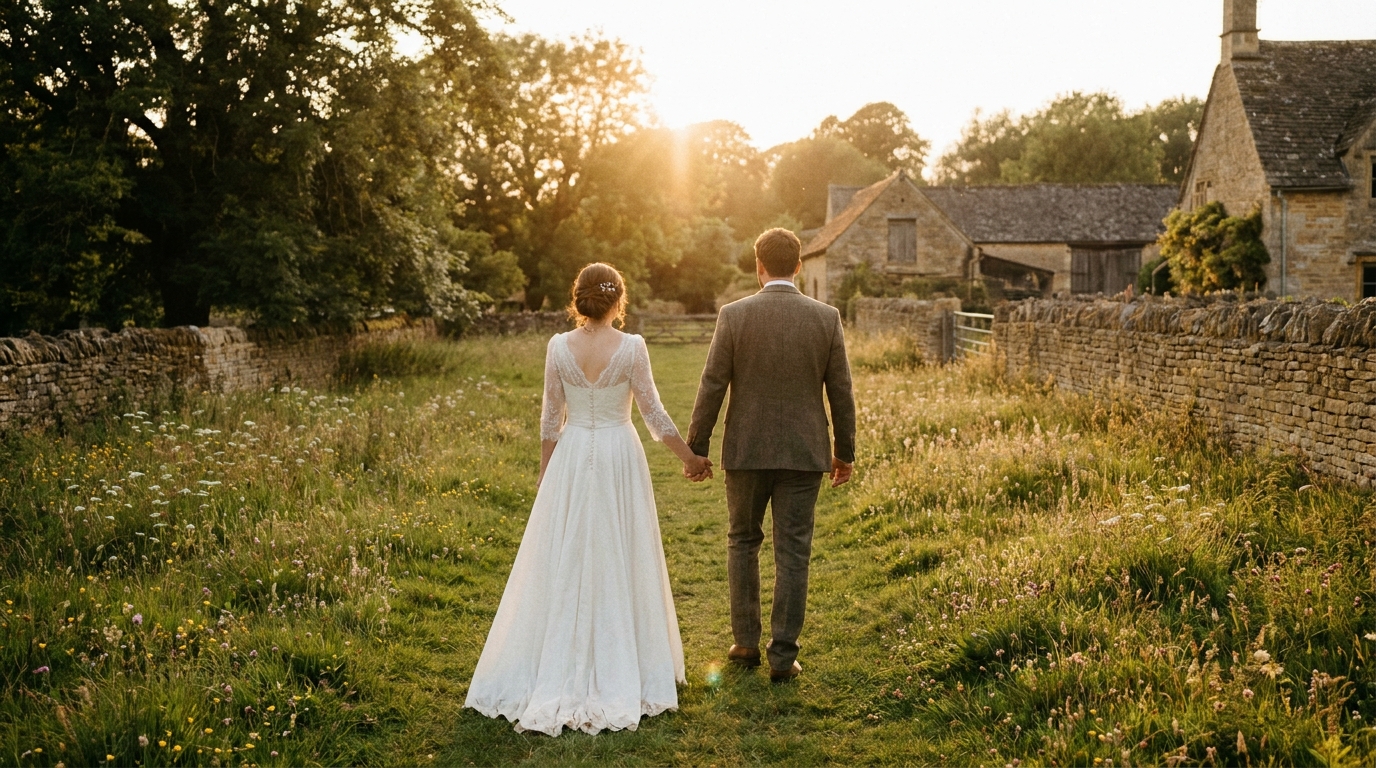
If you’re getting married in the Cotswolds or at a countryside estate, we might have stunning grounds to work with – honey-stone walls, wildflower meadows, ancient woodlands. But we need the time to use them properly. Ten minutes rushing between the reception and dinner just doesn’t cut it.
Here’s my top tip: schedule your couple portraits for the golden hour, which in the UK is roughly an hour before sunset. In summer, that might be 7:30–8:30pm. In autumn or early spring, it could be 4:30–5:30pm. Check the sunset time for your wedding date and work backwards. The light during golden hour is warm, soft and incredibly flattering – and it looks absolutely stunning on film.
Group Shots: 20–30 Minutes
I know, I know – group shots feel like a chore. But your family will genuinely love having them in the film, and they’re over much faster when they’re properly organised.
Work with your photographer (and me) to plan a specific group shot list in advance. Keep it to the must-haves: immediate family, wedding party, close friends. The more people in a shot, the longer it takes to organise. For every 10 people in a shot, add roughly two minutes of wrangling time.
First Dance and Evening: 30–60 Minutes of Evening Coverage
If you want your first dance in the film – and most couples do – make sure I know the timing. I’ll position myself before the song starts. If you’re planning sparkler exits, confetti moments, or any other evening magic, let me know in advance so I can plan accordingly.
A Sample Wedding Day Timeline
Every wedding is different, but here’s a realistic example of a timeline that works well for filming. This is based on a 1pm church ceremony followed by a countryside reception – fairly common for Cotswolds and Midlands weddings.
10:00am – Videographer arrives at bridal prep location
10:00–11:30am – Getting-ready coverage (final hair and make-up, details, dressing)
11:30am – Bridal party departs for church
11:45am – Videographer travels to church ahead of guests arriving
12:00–12:45pm – Guests arrive, groom prep, ceremony setup
1:00pm – Ceremony begins
2:00pm – Ceremony ends, confetti/outside shots
2:15–2:45pm – Group family shots
2:45–3:30pm – Drinks reception (guests mingle, candid coverage)
3:30–4:15pm – Couple portraits (first session – good afternoon light)
4:30pm – Guests called in for wedding breakfast
4:45pm – Speeches
5:30pm – Wedding breakfast
7:30–8:15pm – Couple portraits (golden hour – this is the magic hour!)
8:30pm – First dance
9:00–10:00pm – Evening party coverage
10:00pm – Videographer finishes
This timeline builds in buffer time, includes two rounds of couple portraits (one afternoon, one golden hour), and means nobody feels rushed. Everyone gets to enjoy their day.
Common Timeline Mistakes (And How to Avoid Them)
Scheduling portraits immediately after the ceremony. I see this a lot. You’ve just had an emotionally intense ceremony, there are 150 people wanting to congratulate you, and your family is trying to coral everyone for photos – and somehow you’re also supposed to disappear for portraits. It’s too much. Build in at least 30–45 minutes of reception drinks time before portraits.
Underestimating travel time. If your ceremony and reception are at different venues, add proper travel time – and then add 15 minutes on top. Traffic, cars, guests who need a lift – it all adds up. I’ve seen couples arrive at their reception 45 minutes late because they didn’t account for a 20-minute drive becoming 40 minutes with a bridal car.
Forgetting about the light. This is the big one. In the UK, especially in autumn and winter, it gets dark early. A November wedding with a 2pm ceremony might mean golden hour happens during your wedding breakfast and you miss it entirely. Check your sunset time as soon as you have your date confirmed, and build your timeline around it.
Not sharing the timeline with your videographer. I can’t tell you how many times I’ve arrived at a wedding without a proper timeline and spent the first hour piecing together what’s happening when. Share everything with me – the full schedule, the venue layout, any surprises you’re planning (a flash mob, a surprise singer, a fireworks display). The more I know, the better I can prepare.
How I Work With You on Your Timeline
When you book Moonstruck Videos, one of the things we do in our pre-wedding consultation is go through your day together. I ask questions like:
- What time is your ceremony, and how long do you expect it to run?
- Where are you getting ready, and is it different from the ceremony venue?
- What time is sunset on your wedding date?
- Are there any moments you absolutely must have in the film?
- Are there any surprises planned that I need to know about?
From there, I’ll often make gentle suggestions – like shifting portraits to golden hour, or building in an extra 20 minutes of buffer between the ceremony and drinks reception. I’m not here to take over your day. I’m here to make sure your film captures it at its very best.
A Few Final Thoughts
Your wedding day will go fast. Genuinely, shockingly fast. You’ll blink and it’ll be over – the flowers gone, the candles blown out, the guests heading home. Your film is how you get it back.
The couples I’ve worked with who’ve been most thrilled with their films are always the ones who gave the day space to breathe. Not a military schedule, but a thoughtful one – where the portraits happened in beautiful light, where there was time to sneak off together for ten minutes, where nobody was chasing the clock.
If you’re planning your wedding in the Midlands or the Cotswolds – or anywhere across the UK – and you’d like to talk through how to build a timeline that works beautifully for both your day and your film, I’d love to hear from you. You can get in touch through the contact page, and we can go from there.
Your wedding day deserves to be remembered exactly as it was. Let’s make sure it is.
Lucy – Moonstruck Videos